
The Development Revolution of the AI Era: Why Documentation Is Better When There's Less of It
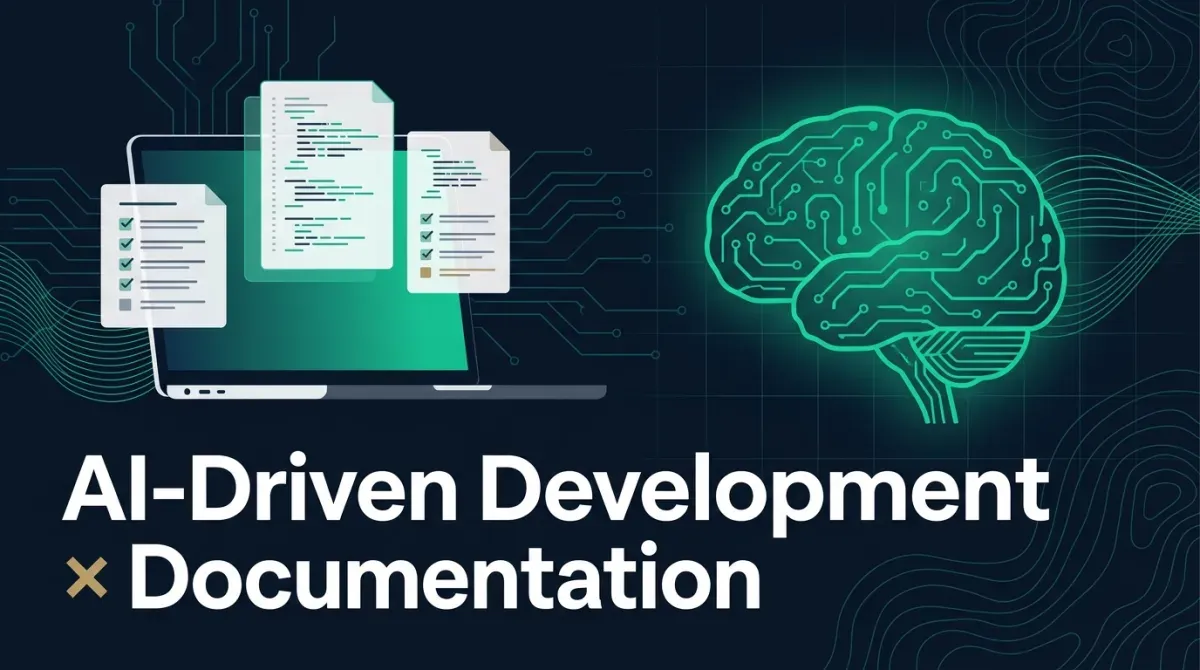
A paradigm shift has arrived
In 2025, the world of software development has hit a major turning point. With advanced AI development tools like Claude Code, GitHub Copilot, and Cursor, it has become realistic to hand most of the code generation to AI. And yet, many development teams still use a “human-centric” documentation system carried over from the 20th century.
Did you know that this old habit is significantly holding back development efficiency in the AI era?
The fatal problem with traditional documentation structures
In traditional projects, it was common to produce 19 categories and more than 106 documents — a vast set of materials, finely subdivided to be easy for humans to understand, from a project charter all the way to a security checklist.
But for AI, this structure causes serious problems:
1. Wasting the context window. When AI implements a single feature, it reads related document after related document, burning more than 15,000 tokens before it even generates code. Given a 200,000-token limit, that’s extremely inefficient.
2. Duplication and contradiction. For example, a password requirement might be “8+ characters” in BUSINESS_RULES.md, “10+ characters” in DOMAIN_MODEL.md, and “6+ characters” in API_SPECIFICATION.md. The AI can’t tell which is correct.
The power of an AI-optimized 7-document structure
In the AI-driven development we propose, those 106 documents collapse into 7 core documents:
MASTER.md— the integrated master document for AIPROJECT.md— vision and requirements, unifiedARCHITECTURE.md— the core of system designDOMAIN.md— business logic, consolidatedPATTERNS.md— the implementation-pattern guideTESTING.md— the AI-driven testing strategyDEPLOYMENT.md— distribution and release strategy
With this structure, AI retrieves the information it needs efficiently and generates consistent, high-quality code.
Striking results
Applying this approach on a real project produced dramatic improvements:
- Development speed: up 75% (8 hours → 2 hours on average)
- Bug rate: down 80% (15 per 100 lines → 3)
- Code-review time: down 75% (2 hours → 30 minutes)
- Documentation-update time: down 83% (3 hours → 30 minutes)
The cost impact is large too. The old approach consumed 15,000 tokens per request, around $450/month; after AI optimization it dropped to 3,000 tokens — $90/month, a $4,320 (80%) annual saving.
Three principles of success
1. Less is More. Prioritize quality of information over quantity; write only what is clear and implementable.
2. Single Source of Truth. Don’t write the same information in multiple places; eliminate duplication entirely to maintain consistency.
3. AI-First Thinking. Understand AI’s constraints and strengths, and design the optimal division of labor between humans and AI.
Looking ahead
AI-driven development has only just begun. As context windows grow and processing costs fall, AI that can efficiently handle more documents will surely emerge.
But under the technical constraints of 2025, a “lean and focused” documentation strategy is the most practical and effective approach. Now is exactly the time to move from the 20th-century “human-centric” documentation culture to a new “human–AI collaboration” paradigm.
Technology will keep evolving, but the essence of development — understanding requirements and delivering business value — doesn’t change. Precisely because it’s the AI era, let’s pursue a more essential, more efficient way of building software.
This article is also available in Japanese.
More from the blog
Why AI Spec-Driven Development Was Born — Its Originator on the Origin and the Road to Proof
I used to think 'letting AI build software is impossible.' FeelFlow CTO Futoshi Okazaki looks back on why he changed his mind — the origin of AI Spec-Driven Development and the numbers that proved it out on our own SaaS.
- AI Spec-Driven Development
- AI Development
- AI Coding
- AI Agents
Who Decides What, and How Does AI Execute? — Reading the Division of Labor from Anthropic's Claude Code Analysis
Anthropic's Claude Code usage analysis reveals a division of labor: humans set the goal, constraints, and definition of done; AI handles exploration, editing, and execution. From official data on ~400,000 sessions, here's what engineers should hold onto in the AI era.
- Claude Code
- Anthropic
- AI Agents
- AI Spec-Driven Development
Claude Code in Large Codebases: Best Practices and Where to Begin
Anthropic's guide to running Claude Code in large codebases is a practical starting point for organizations adopting AI coding at scale. We break down Agentic Search, the harness around the model (CLAUDE.md, Hooks, Skills, Plugins, MCP, LSP, Subagents), three design patterns, and where to begin.
- Claude Code
- Anthropic
- AI Agents
- AI Coding